Showing posts with label Real Estate. Show all posts

Monday, January 26, 2015

Nandan Nilekani shells out Rs 22.5 crore for sea-facing Mumbai apartment


Nandan Nilekani shells out Rs 22.5 crore for sea-facing Mumbai apartment 

Nandan Nilekani shells out Rs 22.5 crore for sea-facing Mumbai apartment

In Mumbai's property market, records don't stay for long. 

In one of the most expensive apartment transactions in India, InfosysBSE 0.84 % co-founder Nandan Nilekani paid about Rs 1.29 lakh per sq ft, or Rs 22.5 crore, for a sea-facing apartment in the marquee Samudra Mahal building at Worli in South Mumbai, three people familiar with the matter said. 


The deal for the 1,750-sq-ft three-bedroom property is the second most expensive transaction ever on a per-sq-ft basis for a residential apartment in the country. Nilekani has bought this apartment on the 17th floor though a privately held company. 

Recently, Nilekani was in the news after he bought a bungalow on a six-acre plot in Tamil Nadu's Coonoor district. The bungalow, The Gables, had been the home of the grandfather of Alan Turing, the British computer scientist and mathematician who is often called the father of the modern computer. 

Pravin Agarwal, seller of the Samudra Mahal apartment, is chairman of Sterlite Power Grid Ventures and brother of Vedanta Resources Chairman Anil Agarwal. Anil Agarwal also owns a bungalow, a duplex and another three-bedroom apartment in the Samudra Mahal complex. 

Nilekani didn't respond to an email seeking comment. In a text message, Pravin Agarwal's son Pratik Agarwal said the family won't comment on the matter. The previous transaction at Samudra Mahal was concluded at Rs 1.11 lakh per sq ft in October 2014, when Siddharth Yog, founder chairman of private-equity Xander Group, bought a sea-facing 3,640-sq-ft, fourbedroom duplex for Rs 40.5 crore. The latest purchase was at a rate just short of the odd Darshan Heights deal executed in 2013 at Rs 1.35 lakh a sq ft. That property on the tony Mount Pleasant Road in South Mumbai's Malabar Hill locality was bought by Bulchandanis, a prominent business family. The duplex came with a 1,400-sq-ft terrace and 700-sq-ft garage. 
Nilekani's property deal clearly defies the ongoing sluggishness in the property market and indicates the unabated demand for marquee and established properties. Samudra Mahal is known as one of the most expensive residential properties across the country. The family of Narayana Murthy, another Infosys co-founder, also owns a large sea-facing apartment in the building. 
"As far as properties like Samudra Mahal, with its established gentry of high-profile occupiers, are concerned, they continue to fetch benchmark prices irrespective of where the market stands," said Rajiv Jain of Ruchika Sheltor, a property broking firm operating in South Mumbai. "Sale of penthouses and duplex apartments in prime buildings of South Mumbai has been slower for the last few quarters, but buyers have also realised that supply of ready material in this segment is restricted," he said. "Sales traction in this segment is also gaining momentum as buyers see an opportunity." 

Source : http://economictimes.indiatimes.com;  Kailash Babar

Saturday, November 29, 2014

How this online realty company has struck gold

How this online realty company has struck gold


With a team of over 500 in Noida, Gurgaon, Mumbai, Pune, Bengaluru, Chennai, Kolkata and Ahmedabad, PropTiger.com is a one-shop solution for property purchases.
RealtyAt a time when most real estate companies in the real world are struggling to raise money, one company in the virtual world is bucking the trend.

In just three years, PropTiger.com, an online real estate portal started by friends Dhruv Agarwala, Kartik Varma and Prashan Agarwal, has managed to raise $44 million, or about Rs 270 crore (Rs 2.7 billion), in funding from various sources.

The website's biggest triumph came early this week when American media mogul Rupert Murdoch's NewsCorp announced that it had picked up 25 per cent stake for about $30 million, or Rs 183 crore (Rs 1.83 billion), in the company.

With that, Agarwala and Varma, who were classmates at Harvard Business School, and Agarwal, an alumnus of Indian Institute of Technology-Kanpur, managed to pull ahead of a pack of websites pursuing the same business of online property listing.

What sets them apart, says Agarwal, is the wider focus.

Unlike other websites that serve merely as an online directory of property for sale,PropTiger.com allows a potential buyer to access additional information.

"Lack of accurate information is a major challenge for home buyers," says Agarwal.

"Since inception, we have made a significant investment in ensuring quality of data and introduced multiple data-led innovations such as livability scores to compare properties in a neighbourhood, a property portfolio tracker to keep a watch on performance of property investments and up-to-date construction and neighbourhood pictures."

With a team of over 500 in Noida, Gurgaon, Mumbai, Pune, Bengaluru, Chennai, Kolkata and Ahmedabad, the portal is a one-shop solution for property purchases.

This has underlined the company's success in finding investors.

In the first round of funding in 2011, it got $2 million from SoftBank, Horizen Ventures and a few angel investors. In 2012, it received another $5 million from SAIF Partners and Accel Partners.

In addition, the existing investors -- SAIF Partners, Accel Partners and Horizen Ventures -- have also agreed to pump in another $7million over the next few years.

So far 10,000 properties worth over $1 billion have been sold through PropTiger.com, with nearly 40 per cent of its traffic coming from mobile applications.

Before starting PropTiger.com, Agarwala was CEO of GE's infrastructure business in India.

He also led institutional sales for GE in the country.

He holds a bachelor's degree in materials science from Northwestern University, a master's from Stanford University and an MBA from Harvard. Agarwal too has formerly worked at GE.

Agarwala's first business enterprise was a financial advisory firm called iTrust that he started in 2006 along with Varma.

The idea of a property website struck them after they realised that there weren't many websites catering to people who were looking at property as an investment.

In 2011, they sold iTrust to the Karvy Group and decided to focus on real estate instead. While Varma was a co-founder, he is no longer actively involved with the property business.
The image is used for representational purpose only
Source : http://www.rediff.com ;  

Saturday, October 25, 2014

Old News - Super-luxury Rs 100-cr flats in India

Why Indian Luxury Residences Don't Match Up to International Standards


(L-R) NCPA Apartments, Mumbai; One Hyde Park Apartment, London. Image courtesy: BCCL, Reuters
Mumbai is no exception to the global trend of fancy duplex apartments in exclusive residential enclaves fetching astronomical prices. A 10,000 sqft apartment in the 60-storey Imperial Heights at Tardeo fetched its developer S D Corporation over Rs 90 crore a few years ago. But a company official said the price was "much, much lower" for the five-bedroom apartment with a deck. Recently, a sample flat of 4,000 sqft on a lower floor went for Rs 32 crore.

At Nepean Sea Road, the upcoming skyscraper Lotus Villa built by the Satellite Group on the erstwhile Morarka bungalow property, is touted as one of the most expensive buildings in India. Sources said a few duplexes-over 10,000 sqft each-sold in excess of Rs 60 crore each. The builder had earlier quoted Rs 100 crore for each flat, but failed to receive any offers at that price.

On Pali Hill, Bandra, two apartments in the newly constructed 20-storey Sandhu House are believed to have been sold for Rs 38 crore each to a Dubai-based NRI. The super-built-up area of the flat is 6,700 sqft, but the actual carpet area is around 3,500 sqft. At Worli Seaface, a politically connected builder recently bought a 10,000 sqft apartment for around Rs 70 crore.

Architect Hafeez Contractor said the quality of construction of luxury buildings in cities like London and New York is far superior to those in Mumbai. "The construction cost there is five times what it is here. However, land prices in Mumbai are far more astronomical than in these global cities," he said.

Mumbai's Luxury Buildings Inferior to Global Standards
Piramal Group chairman Ajay Piramal, whose Piramal Realty builds premium apartments in Mumbai, said although local developers are matching the amenities, the "finishing and construction quality is far superior abroad". In Mumbai, people want to use every square inch of FSI, he added. Piramal said cities like London attract businessmen from all over the world as they find it a safe investment destination and safe to live in.

Property developer Ravi Vaswani said the Indian consumer is not always willing to pay a premium price. A Mumbai developer said Indians want to do their own furnishings and interiors. "Our larger flats are offered as bare shells. Abroad, such condominiums are fully furnished," he said.

Richard Osborne-Young, the London-based director (residential) of property consultants, Jones Lang Laselle, said there is strong demand for luxury apartments mainly from buyers in Russia and the Middle East. Prices in the premium segment range from £2,000 (Rs 1.48 lakh) per sqft to £6,000 (Rs 4.44 lakh) per sqft. "Larger the apartment higher the cost per square foot," said Osborne-Young. "London developers realized overseas money the city attracts is mainly for large apartments. They offer more security compared to a house, which is more vulnerable," he said.

A Mumbai developer said that prices in New York are based on carpet area while in Hong Kong and Mumbai rates are 50 per cent higher than the carpet area.

Source : Nauzer K Bharucha, http://luxpresso.com

------------------------------------------------------------------------------------------------------------

New set of Rs.100 crore homes rises in Mumbai

Areas such as Worli and Lower Parel are emerging as the new tony neighbourhoods in Mumbai

At the World Towers project in Upper Worli of Lodha Developers Ltd, homes are priced between `12 crore and upwards of `100 crore in three towers, World One being the most expensive. Photo:
At the World Towers project in Upper Worli of Lodha Developers Ltd, homes are priced between Rs.12 crore and upwards of Rs.100 crore in three towers, World One being the most expensive. 

Home sales, especially of luxury apartments, have been tepid in most large Indian cities, but that hasn’t deterred a clutch of Mumbai developers from launching apartments priced at about Rs.100 crore each, or a little more than $16 million. 

That’s about $300 per square foot for an apartment. To put that in perspective, the median price of a luxury apartment in Manhattan was $4.2 million, Bloomberg reported in July. 

With conventionally expensive south Mumbai localities such as Malabar Hill and Altamount Road becoming saturated, areas such as Worli and Lower Parel are emerging as the new tony neighbourhoods in the country’s financial capital.

Forthcoming projects in these areas, many of which are replacing dilapidated housing societies and slums, may not offer the quiet and privacy of an Altamount Road address, but make up for that in terms of size, a view of the sea and a promise of exclusivity.

It’s not that demand for luxury residences has suddenly revived, but several of these projects are coming up in prime neighbourhoods where real estate firms can’t price the homes any lower than a few crore rupees. To maximize profit, the builders are adding larger residences at far more exorbitant prices that only the seriously rich can afford.

In the last week of July, Omkar Realtors and Developers Pvt. Ltd, a mid-sized developer that focuses on slum redevelopment projects in Mumbai, launched Omkar 1973 Worli. The 400 apartments here are being marketed as so-called bespoke sky bungalows (made to the customers’ specifications) of 2,500-18,200 sq. ft. and priced at Rs.15-100 crore.

In the Rs.100 crore category are 25 apartments, one per floor, that will offer a 360-degree view of the city. 

Omkar Realtors’ officials said the pre-launch reception for the project was positive and all the apartments in one of the three towers had been sold.

“We hope to sell off the entire stock in three-four years,” said Bharat Dhuppar, chief marketing officer at Omkar and chief project officer of 1973 Worli.

Another four acre project in Worli, being developed by K Raheja Corp., claims to be more exclusive, with 80-90 homes of 5,000-20,000 sq. ft. While the apartments at Omkar are priced at Rs.38,000-40,000 per square foot, at K Raheja Corp.’s 42-storey single tower project, the rate is about Rs.50,000 a square foot; the larger apartments here cost Rs.90-100 crore or more.

“It’s a niche project and will not have a proper launch because it doesn’t require any marketing or publicity. Work has already started and sales will happen to a select group of buyers by word of mouth,” said a company official, declining to be named.

Mumbai was ranked the 16th most expensive residential location in the world in the last quarter of 2012, according to the Wealth Report released in March by property advisory firm Knight Frank. Monaco, Hong Kong and London topped the list. Mumbai was the only Indian city in the top 20.

For wealthy individuals with net worth upwards of Rs.25 crore and annual income of Rs.3.5-4 crore, the key factors in buying a luxury home are: location (25%), interiors (18%), size (16%), exclusivity (15%), architecture (13%), automation (8%) and price (5%), Kotak Wealth Management and Crisil Research said in their Top of the Pyramid 2013 report released this week.

Developers have selectively and cautiously launched luxury projects in large property markets such as the national capital region centred on New Delhi, Bangalore and Chennai in the recent past, wary of the demand these would generate.

According to Om Ahuja, chief executive of residential services at real estate consultant Jones Lang LaSalle (India), there is good demand for residential apartments priced at about Rs.10 crore from interested, but choosy customers who haven’t been hurt by the economic slowdown.

“Density, reputation of the developer, location, neighbours are some of the criteria they look at before buying, and when you consider all these they have limited choice,” said Ahuja. “Worli continues to be a hot spot among buyers.”

But sales of luxury residences have dropped in most cities, said Pankaj Kapoor, managing director of Liases Foras Real Estate Rating and Research Pvt. Ltd.

“The luxury segment grew the most between 2006-08, after which it didn’t revive fully. However, in the last two-three years, there has been a huge supply of luxury residences in Mumbai in newer areas such as Lower Parel, which don’t match the standard of south Mumbai,” Kapoor said.

“In Mumbai, because of the many redevelopment incentives that are given to developers for projects in south and central Mumbai, there is a lot of supply coming in,” he said. “But where are the buyers?”

Developers aren’t unaware of the risks. To attract a wider range of buyers, many builders of luxury residences are selling smaller homes at lower prices than the larger, costlier homes. 

At the World Towers project in Upper Worli of Lodha Developers Ltd, homes are priced between Rs.12 crore and upwards of Rs.100 crore in three towers, World One being the most expensive.

The most expensive homes in the World One tower—duplex flats—occupy two entire floors and offer 360-degree views of the city, set at a height of about 1,000 ft. above the city. The residences have double-height living rooms, private pools and private gyms, said chief marketing officer R. Karthik. 

A Lodha Developers spokesperson said around 60% of the project had been sold so far. It was announced in 2010.
Property analysts said Lodha’s proposed project in Altamount Road, a property it acquired from the US Consulate last year, will be in a similar price category. Lodha hasn’t disclosed its plans yet.

At Sunteck Realty Ltd’s Signature Island project in Bandra-Kurla Complex, a business district in Mumbai, two levels comprising 16 residences have been reserved to be sold later. The developer is looking for tie-ups to make these more exclusive than those in the rest of the project. For the other units, the sale price is Rs.50,000 per square foot.

“For the right location, the ultra HNIs (high networth individuals) are sometimes willing to pay staggeringly high prices, irrespective of the general state of city’s property market,” the Kotak-Crisil report said.
However, even these individuals are beginning to postpone big-ticket purchases. “The supply of luxury houses is high, but the UHNIs have become very cautious. There is a double-digit drop in the demand,” said Manoj Mohta, director (customized research) at Crisil Ltd.
Source : http://www.livemint.com, Madhurima Nandy, Unnikrishnan S. 

-------------------------------------------------------------------------------------------------------------------------------------------------------------------

Mumbai finds no takers for super-luxury Rs 100-cr flats
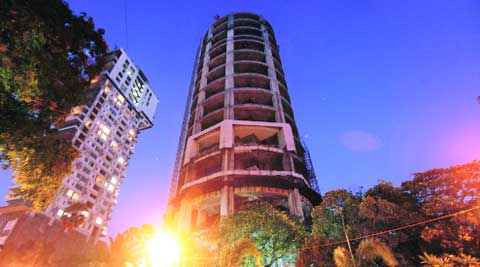
The 55-storey Sasen building. (IE Photo: Pradeep Kochrekar) 

The palatial 15,000 sq ft duplexes in the under-construction 55-storey Sasen building on tony Napean Sea Road offers the country’s costliest residences at Rs 100-120 crore each. But for six years now, the project, earlier known as Lotus Villa, has not sold a single unit.
Since the 2006 boom, similar islands of super-luxury residences carrying price tags of over Rs 20 crore each have come up in the city. However, almost half of these remain unsold, reducing new launches to a trickle, according to data compiled by real estate research firm Liases Foras.

The city has a total marketable supply of 1,000-odd apartments spread across 27 premium residential projects priced at Rs 20-100 crore each. According to the available data, 85 per cent of such projects were launched between 2006 and 2010.

Over the last two years, just one new project — 1972 Omkar in Worli — has been launched in the Rs 20 crore-plus segment.

The pattern of unsold stock repeats itself across big ticket projects that are on offer from listed players like Indiabulls Bleu in Worli, D B Realty’s Orchid Heights and Orchid Turf view in Mahalaxmi and Razzak Heavens by Orbit group on Napean Sea Road.

Pankaj Kapoor, managing director, Liases Foras, said at today’s rate of absorption, it will take another 100 months (over eight years) for the existing stock to be sold.

“The ideal rate of absorption in a healthy market should not be more than 20 months in the super-luxury segment. In fact, our data on unsold super-luxury houses itself is an underestimation. If the stock being held by investors rolls back into the market, the actual

Source : Shalini Nair, http://indianexpress.com

------------------------------------------------------------------------------------------------------------

Rs 100-crore apartments are hot!


At a time when prices are merely notional if the address is right, it's hardly surprising that the cost of residential properties in New Delhi and Mumbai are going, quite literally, through the roof. Hold out long enough for the right buyer and even the most generous estimates by real estate agents or consultants could go awry.
And as Indians gain the confidence to spend as well as aspire to A-lists everywhere, a few more crores are hardly likely to matter when the price of even an apartment matches that of a decent, mid-sized company!
Only a week ago, the Oswals bought a bungalow on an acre of land on New Delhi's Tilak Marg (in prestigious Lutyens Delhi) for Rs 100 crore (Rs 1 billion). Other industrialists who own houses in the neighbourhood are steel tycoon Lakshmi Mittal, Bharti Enterprises managing director Sunil Bharti Mittal and DLF chairman K P Singh.
The most a property in this central part of Delhi has fetched is a whopping Rs 137 crore for a bungalow on Amrita Shergill Marg, becoming the most expensive residential real estate to change hands in India. The one-acre plot was purchased by Sanjay Singal of Bhushan Power & Steel.
Lakshmi Mittal, who bought a 12-bedroom mansion in London's Kensington Palace Gardens in 2004 for $125 million (Rs 550 crore), also got a slice of Delhi's residential pie for a more modest Rs 40 crore (Rs 400 million) on Prithviraj Road. Today it is valued at Rs 80-100 crore (Rs 800 million- Rs 1 billion).
According to real estate anaysts, Treveni Infrastructures picked up a 2.8 acre property on Sikandra Road for Rs 115 crore (Rs 1.15 billion). In another recent transaction, the Jindals bought a 3.2 acre property on Mansingh Road for Rs 125 crore (Rs 1.25 billion).
If Lutyens Delhi is the city's power address, in its Tony Khan Market or Jorbagh areas you should expect to pay Rs 3 lakh per sq yard. On S P Marg, where liquor baron Vijay Mallya owns a house, the going rate is around Rs 5 lakh per sq yard.
There is news now about highrise apartments being developed in central Delhi's Connaught Place. These 4,000 sq ft apartments could cost as much as Rs 16,000 per sq ft or Rs 6.4 crore (Rs 64 million) overall.
DLF is building a nine-storey apartment complex on 2.5 acres in W-block of Greater Kailash II, in south Delhi. These 6,000 sq ft apartments are being sold for over Rs 21 crore (Rs 19,000-25,000 per sq ft), by invitation only. Sources tell us about a possible development of apartments and individual bungalows by DLF in GK-II's E-block.
DLF also has a plan for very high-end villas in posh Chanakyapuri. These 6,000-7,000 sq ft villas could cost between Rs 12-14 crore (Rs 20,000 per sq ft).
Gurgaon too has some big ones. The top-end penthouse at Ansal's The Ivy could cost between Rs 5-8 crore (Rs 50-80 million). A 2,500-4,500 sq ft apartment at DLF's new Park Place and Park Tower ranges between Rs 1.75-3.15 crore (Rs 17.5-31.5 million). Omaxe's The Forest Noida offers apartments ranging from 4,000-6,500 sq ft for Rs 2.25-4.5 crore (Rs 22.5-45 million).
Delhi may have raised the bar where expensive residential rates are concerned, but Mumbai is still leagues ahead on average.
"Every second building in Mumbai commands a huge price, anything above Rs 25,000 per sq ft to sometimes even upto a whopping Rs 75,000 per sq ft," says architect Hafeez Contractor.
The NCPA Apartments at Nariman point are among the most expensive in Mumbai with an uninterrupted view of the sea. Rs 60,000 per sq ft is the current rate there. The vice-chairman of Reliance Capital, Amitabh Jhunjhunwala, recently bought a 2,880 sq ft apartment at NCPA for Rs 18 crore (at Rs 63,000 per sq ft).
Other expensive areas in Mumbai are Cuffe Parade, Napeansea Road, Carmichael Road, Altamount Road and now Worli and Bandra as well.
Shah Rukh Khan's bungalow Mannat, on Bandra Bandstand, is currently valued between Rs 70-100 crore (Rs 700 million-Rs 1 billion). The approximate rate here is Rs 30,000-plus per sq ft, as opposed to Rs 15,000-20,000 per sq ft at Juhu, where Amitabh Bachchan owns a bungalow.
Indiabulls promoter Saurabh Mittal recently bought a 5,500 sq ft apartment in Maker Building on Cuffe Parade for Rs 40 crore (Rs 400 million). The rate here is a whopping Rs 72,000 per sq ft.

A recent transaction in Sunita Building on Malabar Hill for a 3,450 sq ft apartment, where the rate is even higher, fetched Rs 1.03 lakh per sq ft. Leading stockbroker Rakesh Jhunjhunwala bought a 4,400 sq ft apartment at El Palazzo on Malabar Hill for Rs 25 crore (at Rs 57,000 per sq ft).
Among the most impressive buildings under construction in Mumbai is Shapoorji Pallonji's Imperial Towers on Kambala Hill. Two 65-storey towers, with the first 12 storeys reserved for car parking, have two 25,000 sq ft penthouses on top. At a conservative Rs 50,000 a sq ft, each of these penthouses could cost Rs 125 crore.
Standing tall at 36 storeys, the building on the old Chattan Bungalow site at Altamount Road, being developed by K Raheja Universal, will blow your mind. The first 12 stories offer just amenities.
The remaining 24 storeys have 12 duplex apartments stacked on top of each other. Each apartment has its own huge terrace and an elevator to take the car right up to the living room. The whole building itself is on a hill, enhancing the view.
The view might be better from the top, but luxury living seems to be a goal in itself.
Source : Ravi Teja Sharma, http://www.rediff.com
-------------------------------------------------------------------------------------------------------------------------------------------------------------------

Mumbai's Rs 100-cr flats

Jacuzzis and sit-out decks are standard in these high-ceiling, 13,000-sq ft homes high above the city


The loud whirring of machines and generators from nearby industrial premises is cut off as one enters a soundproofed glass building at the site of Omkar 1973 in Worli. This is one of the few recently-launched super-luxury projects, where somewill claim an astounding Rs 100 crore and where outrageously rich buyers are being courted. Six months after sales opened, three of the seven premium flats have been booked, says Babulal Varma, managing director of Omkar Realtors.

As one might expect in a Rs 100-crore home, everything gleams gracefully. The supple rugs are cut out for John Lobbs or Jimmy Choos .

Each adornment is picked after careful deliberation and sourced mainly from foreign countries, the developers declare. Lodha tied up with Armani/Casa, the luxury interiors division of Giorgio Armani, for its World Towers, with mansions set at 1,000 feet above the city. At the Omkar project, in the living room decorated by Hirsch Bedner Associates, the chandelier with leaves fashioned from crystal and silver came from the Czech Republic. The furniture - velvety sofas and swanky wooden tables - was imported from Spain and Germany.

These homes are palatial flats or duplexes, spread across 13,000-18,000 square feet, with ceilings that are 14 feet high. "In Delhi, you have the concept of farmhouses, which are often worth hundreds of crores. There is a similar clientele inbut geographic restrictions don't allow us to build farmhouses," says Varma. "So we wanted to create that kind of luxury in an apartment."

The Rs 100-crore apartments have 360-degree views and because they are landscaped and dramatically elevated, the temperature is (according to brochures) at least 5 degrees cooler even without air conditioning. The living room has a sit-out deck with informal furniture while the bathroom leads to a deck with an open-air jacuzzi. A number of buyers are said to prefer gardens to jacuzzis on the deck. Not entirely surprising in a city starved of green spaces.

Habitation often starts around the 10th or 15th floor, the lower levels being reserved for parking and common entertainment areas. For exclusivity, there is a dedicated concierge service, personal lifts that open into the living room and a separate entry and staying area for the household help.But many developers also make bare-shell home that buyers can decorate according to their desires. "The buyer has his or her own thought process and expectations are sky high," says Mudassir Zaidi, national director, residential services at Knight Frank. Also, since the core and key beams on the exterior walls bear all the weight of the structure, the inner walls can be demolished and remodelled as buyers please.
* * *
Big businessmen and industrialists are willing to part with enormous premiums to minimise the commute, prompting plush residential projects to emerge around commercial hubs such as Worli, Lower Parel and Bandra-Kurla Complex. ICICI Bank CEO & MD Chanda Kocchar and a top cricketer are rumoured to have scouted for such apartments in central Mumbai. A few are located in old, celebrated parts of south Mumbai, including Altamount Road and Nepean Sea Road. All homes are sold "by invitation only", which means buyers will share an address only with fellow members of the swish set. Developers reach out to the high-net-worth individuals or request those interested in buying these flats to send them a profile. Appointments are given after a thorough screening. Besides Omkar, Lodha Developers, Avighna Group and Sunteck Realty are some other developers in the space.
Source : Ranjita Ganesan, http://www.business-standard.com  

Wednesday, October 15, 2014

DLF stock fell 28% after Sebi order

Housewives of DLF: How the spouse factor led to Sebi crackdown

Housewives of DLF: How the spouse factor led to Sebi crackdown
Reuters

While barring realty major DLF, its chairman KP Singh and five other senior executives from capital markets for three years, market regulator Sebi noted the role of three women it refers to as 'housewives' for their role in the matter and has revealed the complex dealings that go into real estate deals in India. (Read full text of order here)
The basis of the complaint against DLF was one Kimsuk Sinha who filed complaints in 2007 alleging that he had been duped of Rs 34 crore by Sudipti Estates Private Limited and related persons for the purchase of land.
He alleged that the firm was controlled by DLF Home Developers and DLF Estate Developers that were both part of DLF group and sought that the company not be allowed to list on the markets. However, the allegations were refuted by DLF, who said that the Sudipti Estates wasn't a part of the group.
However, Sebi in a show cause notice to the company noted that three real estate companies, Sudipti Builders, Felicite and Shalika lay at the heart of the controversy and the deals to acquire land.
In its show cause notices, the market regulator noted how three arms of DLF divested stake in Felicite to three 'housewives': Madhulika Basak, Niti Saxena and Padmaja Sanka all of whom happened to be wives of key managerial persons in DLF.
Here are the two charts that seek to explain the shareholding pattern:
Chart2
Image courtesy: Sebi order
Chart1
Image courtesy: Sebi order on DLF
Sebi in its show cause notices pointed out that despite divesting stake in the three companies, DLF continued to retain control of the three real estate companies, one of which was accused of fraud.
However, DLF refuted the show cause notice by Sebi saying that it wasn't illegal for a person to invest in a company's shares merely because she was a housewife or because a joint account held with her husband was being used to fund transactions.
"The fact that the spouses of certain employees of DLF were shareholders of Felicite does not lead to a legal inference that Felicite is a subsidiary of DLF," the company said in its submission.
The company also refuted the allegation that the 'housewives' continued to hold stake in one of the companies only while their husbands were employed by DLF. It pointed to the case of one Reema Hinduja who continued to be a shareholder in the company even after her husband quit the company and said that it was wrong to infer that the DLF had any control over the three real estate companies.
However, Sebi whole time member Rajeev Agarwal noted in his order that while it was an undisputed fact that the 'housewives' involved in the real estate companies used joint accounts with their husbands to fund the deals, the women who stake in the three companies weren't even regular investors.
"It is further noted that these 'Housewives' were not regular investors/traders in the
securities market and they did not have any income of their own," the Sebi order noted.
Sebi noted that the three women were the wives of the Group CFO, Senior Vice President (Finance) and Vice President (Finance) of DLF and the three executives were listed as key management persons in the company's prospectus for the IPO.
"They were also subject to the control of DLF due to their "employee and employer relationship". The respective wives held 100% shareholding of Felicite, which in turn held 100% shareholding in Shalika, which in turn held 100% shareholding in Sudipti. Therefore, it has been alleged that DLF never lost control of Felicite, Shalika and Sudipti," the order noted.
Sebi noted in its order that the purchase of all shares in Felicite were not made by the 'housewives' but their husbands and also pointed to the fact that the shares held by the women were only transferred to the wives of other senior management of DLF.
"In my view, it cannot be just a coincidence that Felicite is incorporated on March 26, 2006 with its 100% shareholding held by the wholly owned subsidiaries of DLF, those wholly owned subsidiaries subsequently sold their entire shareholding in Felicite to the 'Housewives' of three KMPs who made payments for the purchases made by their respective wives and subsequently, they transfer their entire shareholding to the DHDL (one of the three initial shareholders), wholly owned subsidiary
of DLF and the 'Housewives' of other KMPs," the order noted.
Sebi noted that the DLF management had employed a "plan, scheme, design and device to camouflage the association of DLF with its three subsidiaries namely, Felicite, Shalika and Sudipti" and noted that the realty major had actively concealed the filing of an FIR against one of the subsidiaries when it was filing for an IPO.
"In the facts and circumstances of this case, I find that the case of active and deliberate suppression of any material information so as to mislead and defraud the investors in the securities market in connection with the issue of shares of DLF in its IPO is clearly
made out in this case," the order noted.
Sebi noted that DLF suppressing the information about its subsidiary companies in its IPO filing constituted a grave offence and had larger implications on the safety and integrity of the capital markets.
"In my view, for the serious contraventions as found in the instant case, effective deterrent actions to safeguard the market integrity. It, therefore, becomes incumbent to deal with contraventions, digression and demeanour of the erring Noticees sternly and take appropriate actions for effective," the order noted while barring the DLF executives for three years.
----------------------------------------------------------------------------------------------------------------------------------

Sebi’s clampdown on DLF exposes India Inc’s dirty secret about subsidiaries

Sebi’s clampdown on DLF exposes India Inc’s dirty secret about subsidiaries
Reuters
Cases disposed off by Company Law Board have almost invariably a common thread running through them - the use of subsidiaries for dubious purposes.  In fact, in the Indian context subsidiaries present a classic example of wheels within a wheel.  There are companies with hundreds of subsidiaries as the Sebi order on DLF vividly brings out.  Though in effect they are all subsidiaries, the multi-layering confers a sort of anonymity on some of the distant subsidiaries, so much so that the ultimate holding company glibly washes its hands off them and contends that it has nothing to do with them.
This is precisely what the saga of DLF all about as fas as its murky deals in the run up to the IPO in 2008 is concerned.  Some of the companies, which were admittedly subsidiaries, morphed into independent entities having nothing to do with DLF with housewives of key managerial personnel of DLF becoming their shareholders.  (Read more about that here)
Sebi's meticulous investigation showed that the housewives were just fronts for DLF---the money with which the housewives purchased the shares of these subsidiaries were in the final analysis provided by DLF.  And these subsidiaries owned a sizeable part of the land bank, the major asset of DLF.  The reason why DLF was coy about admitting that these companies indeed continued to be its subsidiaries was that many of the land owned by them were bedeviled by title disputes, a trade hazard of any realty company.
Subsidiaries lend themselves to misuse on two counts.  First, plum assets are owned by them primarily for the promoters of the holding company and their associates.  In other words, the non-promoter shareholders have no claim on such prime assets.  Second, subsidiaries can be used to hide some of the disagreeable assets and liabilities of the holding company.
Since the IPO norms of the SEBI requires disclosure of material facts relating to both the issuing company and its subsidiaries, DLF had hastily de-subsidiarized these companies by roping in innocent housewives of its key managerial personnel.  In fact, the SEBI verdict points out that around that time as many as 288 companies were banished so that they did not legally have anything to do with DLF, though de facto they were all DLF babies. The idea of such wholesale banishment was these companies holding dubious titles should not spoil the IPO party of DLF.
Incidentally, DLF succeeded in its mission---it pulled wool over everyone’s eyes, and walked away with more than Rs 9,000 crore with shares with a face value of Rs 2 issued at Rs 525.  The merchant bankers to the issue happily went along with whatever DLF said or did not say in its prospectus.  The Qualified Institutional Buyers who play the pied piper role in the Indian IPO market also did not think anything amiss in the feverish de-subsidiarization activity in the run up to the IPO.  The biggest loser of course was the public which is now holding the can.
The Companies Act 2013 has done well to stop the wheel within the wheel within the wheel arrangement by prohibiting a subsidiary to be the holding company of another subsidiary.  It has also done well to mandate presentation of consolidated accounts for holding companies which will bring out the true impact of financial transactions with their subsidiaries.  However, neither the company law nor Sebi can stop companies that are not legally subsidiaries but effectively are, say by having stooges like housewives of key managerial personnel as the dominant shareholders. In other words, inconvenient subsidiaries could be dropped like hot potatoes at crucial times.
The SEBI order while making DLF and its promoters persona non grata in the securities market has not delisted the shares of DLF because it knew such a step would hurt the small investors more than anybody else. In a way this is poetic justice -- banishment from the securities market of those who tried to banish inconvenient subsidiaries!
Source : S Murlidharan; http://firstbiz.firstpost.com

Annals of desperate measures: How DLF used the wives of its executives to camouflage control

Annals of desperate measures: How DLF used the wives of its executives to camouflage control


DLF is India's largest listed real estate company.(Reuters/Arko Datta)
The Securities Exchange Board of India (SEBI) order banning DLF, India’s largest listed real estate developer, and six of its executives from the securities markets for three years features a curious list of 10 women—the “housewives,” as the country’s market regulator terms them.

These women, all wives of senior company executives, are contended to have been utilized by the Gurgaon-headquartered real estate giant to remain in control of Sudipti Estates Private Limited, Shalika Estate Developers Private Limited and Felicite Builders and Construction Private Limited, companies at the heart of the cheating scandal the realty major finds itself embroiled in.

These are the three companies that SEBI ascertains were subsidiaries of DLF but weren’t disclosed by the developer when it went to the market in 2007 to raise Rs9,187.5 crore ($1.50 billion), then India’s biggest IPO.

Shareholding spouses

Between March and November 2006, the shareholding of the three firms—Sudipti, Shalika and Felicite—were effectively transferred from three wholly-owned DLF subsidiaries—DLF Home Developers Limited (DHDL), DLF Estate Developers Limited (DEDL) and DLF Retail Developers Limited (DRDL)—to three women.

Padmaja Sanka, Madhulika Basak and Niti Saxena, who became 100% shareholders in the three companies, were the wives of three high-ranking DLF executives. While Padmaja’s husband Ramesh Sanka was DLF’s Group CFO, Madhulika and Niti’s respective spouses, Surojit Basak and Joy Saxena, both served as senior vice president (finance) at DLF.

After the shareholding transfers were complete, Madhulika Basak and Niti Saxena held 30% each in Felicite and Padmaja Sanka, the spouse of the more senior executive, had a 40% share. Felicite, meanwhile, became 100% shareholder in Shalika, which, in turn, became a 100 shareholder in Sudipta. Effectively, the three women controlled all the three firms.

That is where DLF’s troubles begin.

“All the three transferees were ‘Housewives’ and they held bank accounts jointly with their respective husbands. On this basis, it was alleged that their purchases of shares in Felicite were funded by their respective husbands’ joint accounts,” SEBI said in its order.

“Considering the fact that all these three shareholders were ‘Housewives’ and that the payment towards their purchases of shares of Felicite were made from the joint accounts held with their respective husbands, it has been alleged that DLF never lost control of Sudipti, Shalika and Felicite,” it added.

SEBI also mentions that after the three DLF subsidiaries—DHDL, DEDL and DRDL—transferred their shareholding in Sudipti, Shalika and Felicite, there was no change in the authorized signatories of the banks of these companies, their registered addresses or their auditors.

All taken together, SEBI holds the view that “the entire share transfer process in Sudipti, Shalika and Felicite was executed through sham transactions by DLF and its associates/subsidiaries.”

DLF’s counter

The developer, in its defence, points out that SEBI hasn’t “impugned the validity” of the transfer of shares by the three subsidiaries to the three women.

Further, according to the SEBI order, DLF explained: “There is no disability in law barring a person from investing in shares merely because she is a ‘Housewife’ by profession. Nor can there be an adverse inference regarding the veracity and validity of the share acquisition by such person because the purchase consideration has been advanced from the joint account held by her and her spouse.”

Therefore, the developer argued, that just because “spouses of certain employees of DLF were shareholders of Felicite” it cannot be concluded that Felicite—and resultantly, Sudipti and Shalika—is a subsidiary of DLF.

The Rs20 lakh loans

But when SEBI started digging into the bank accounts of the three “housewives”, which they jointly held with their husbands, it discovered an unusual string of transactions.

Shortly before payments were made from Padmaja Sanka, Madhulika Basak and Niti Saxena’s bank accounts to purchase shares in Felicite, all three accounts were credit with Rs20 lakh each. These monies, according to the SEBI order, came from personal loans extended by Kotak Mahindra Bank to the the husbands: Ramesh Sanka, Surojit Basak and Joy Saxena.

These DLF employees, the order explained, then “transferred the said amounts of Rs20 lakh each to their own bank accounts jointly held with their spouses on November 28,2006, November 10, 2006 and December 16, 2006, respectively. From these bank accounts money was transferred to ICICI bank account no. [redacted] of Felicite.”

Kotak Mahindra Bank extended similar loans to seven DLF executives, and transfers of Rs20 lakh to Felicite were made from the accounts of four of these executives, according to the SEBI order.

More housewives

On December 14, 2006, Felicite allotted 200,000 shares each to 10 individuals, who were all spouses of DLF executives, employees, or directors of group companies in DLF.

Apart from the three original “housewives”—Padmaja Sanka, Madhulika Basak and Niti Saxena—who now held 10.10% each, the seven new shareholders now owned 9.5% each. These included Meenakshi Gupta, Ritu Chawla, Sangeeta Gupta, Saroj Khanna, Mukta Jindal, Nishi Goyal and Seema Sethi.

“Thus, the personal loans taken by aforesaid personnel of DLF were utilized to buy shares of Felicite in the name of their respective wives,” the order explained.

And whenever the husband of a Felicite “housewive” shareholder left DLF—as in the case of Niti Saxena and her husand, Joy—the shares in the company were transferred to another DLF subsidiary or employee’s spouse. Also, personal loans taken by the employees to help their wives buy the shares in Felicite were repaid as the executives left DLF.

Moreover, even after all these shareholding transfer took place—from DLF subsidiaries to initially three “housewives” and finally, 10 spouses—there were no changes in the board of directors of the three companies. They continued to remain employees and retainers of DLF.

“Therefore,” SEBI concluded in its order, “DLF never lost control of Felicite, Shalika and Sudipti.”
Source: http://qz.com
Related Posts Plugin for WordPress, Blogger...

Labels

85th Academy Awards in Hollywood Aam Aadmi Party Aanjaneya Lifecare Aastha channel ABG Shipyard Abhinav Jhunjhunwala-Prerna Sarda Acharya Balkrishna Adani Group Aditi Kothari Aditya Swamy Adlabs Films Limited AirAsia Ajay Piramal Alan Greespan ALBERTA LA GRUP Alfred Cointreau Alibag Alisher Usmanov - Russian billionaire Alkesh Tandon-Raakhe Kapoor Allie Nawrat Amalgamated Bean Coffee Trading Company Limited Amar Chitra Katha Amartya Sen's daughter Nandana Amish Tripathi Amit Bhatia-Vanisha Mittal Amit Burman Amit Wilson Amitabh Bachchan AMP Technologies an online real estate portal Anand Kripalu Anand Mahindra Anant Media Pvt Ltd Anil Jindal Anjali Bansal Anne Hathaway annual report of Prime Securities Anu Aga Apollo Hospitals Enterprise Ltd. Apple Aravind Eye Care System Architect Hafeez Contractor Architecture Arindam Chaudhuri Arokiaswamy Velumani Arvind Kejriwal Arvind Mills Ashni Biyani Ashok Gajera ; Russell Mehta Ashok Piramal Group Ashok Soota Asia 7 AstraZeneca Pharma Atlantic Media ATT author and CEO Autoline Industries Aviation Ayesha Thapar Azim Premji Baba Kalyani Group Baba Ramdev Bain Capital Bangalore and Hyderabad Bank Loan interest rates BankBazaar BANKING TERMS Being Human Bekkit Benjamin Graham Bennett Bennett Coleman & Company Ltd Berkshire Hathway Best Data Recovery Companies in India Best denim brands BF Utilities Bharat Parekh and Ravi Jethani - LIC Agents BharatStudent.com Bharti Infratel Bhulabhai Desai Road off Breach Candy Bhupendra Panwar Big Cinemas Big Gulp and Bakers Street Bilcare Bill Gates’ Corbis photographic collection Bill Miller Binod Chaudhary Birla Pacific Medspa Birmingham-based 2 Sisters Food Group (2SFG) Biz Daughters Black Money Black Swan Theory Block Deals Blue Dart Express Blue star Bluegape BMC BOC India Bombay Blue in Kurla Bombay Dyeing Books BPCL Brady Brand Capital Brands Brazilian private equity firm 3G Capital Brickwork Ratings India Private Limited Brickwork Ratings India Pvt Ltd BRICS BS BSE Buddh Circuit Budget 2013: Do we really need a Women’s bank Burger King Burmans Burn (from Coca-Cola) Business Insider Business of Marriages Business Standard Business World Buzzanytime Cadbury House Cadbury India Canaan Partners CanvasM Capillary Technologies Captain C P Krishnan Nair CARE - Credit Rating Agencies of India CARE and PC Jewellers Career Point Carmichael Road Cash Overseas (Paywall) Casino Resort Castrol Catamaran Investment Private Ltd. Catholic Syrian Bank CDMA Mobile Technology Central Parking Services Chairman of Sajjan India Ltd Charged Voids Chart Moving Average In Excel Chennai CHHATRAPATI SHIVAJI INTERNATIONAL AIRPORT Chick-a-fil Chicken came First Chitrangada Singh Cinemax Cinnamon Teal Citigroup Coal India Coca-Cola Coffee Coffee Day Coffee Day Group Coffee Day Resorts and Global Cognizant Cointreau Coleman and Co Ltd Colvyn Harris Comic books Commodity stocks Companies Company name change Compucom Computer-Generated Women Concierge Construction Cost Copper Chimney Coppock Curve Indicator Analysis Core Education and Technologies Core Projects and Technologies Corporate Centre Cost of a farmhouse Party Costa Coffee Could9 Credit Analysis and Research Ltd. (CARE) CRISIL CRISIL Limited Crorepati Crowdsourcing Currency D-Mart D. Subbarao Dabur Dalai Lama Dalal Street top investors Dalit Entrepreneur Dan Roarty Darshan Patel David Moratilla Daytona 675 and Speed Triple bikes DB Realty DCNS Deccan Gold Mines Deepak Fertilisers Deepinder Goyal Defence Defence-related stocks or military stocks Delhi Assembly Elections 2013 Delhi gang rape case Delhi NCR Delhi Stock Exchange Dell's EqualLogic Della Adventure Delta Corp Demark Technical Indicator Design Atelier Developer Khemchand Kothari Devi Shetty Dharmesh Jain Dharmesh Shah Dhiraj Rajaram DI Corporation Dia Group's sister concern - Lifestyle Tradelinks India DigitalGlobe Disa India Dividend Stocks DLF DLF Emporio DLF Galleria Dollar Domino's Double Top technical analysis DSE Durex DVR Share Easun Reyrolle Education Startups Educomp Solutons Ltd. Edward Snowden Edwin Lefevre Eicher Motors Eko Elections EMA – Exponential Moving Average Entrepreneurs ET ET 500 ET BUREAU ETIG Database Evalueserve Everonn Edu Everstone Capital Expensive houses in the world Expensive Stocks Faering Capital Falguni Nayar FAME Farmax India Ltd. FDI Fed’s interest rate Fidelity Investments FII holding in BSE 500 Finacle Financial crises Financial Technologies Fineotex Chemical Finnish real estate company Exilion first analytical pharmacy first McDonalds restaurant in Kerala in Lulu Mall Fitch Ratings India Private Ltd. Flappy Bird Flipkart Founder - HCL Technologies France' Groupe SEB Fresenius Kabi Oncology Frugal innovation FTIL Fund Manager Desktop Software Future Group Games Ganga Gatorade Gautam Singhania Gayatri Joshi GBP GE Shipping GEICO Genesys International Geodesic Ltd. GeoGlobal’s Jean Paul Roy Geometric George Soros Girish Patel Gita Gopinath Gitanjali Gems and Tara Jewels Gitanjali Gems Ltd Gitanjali investments Glaxo Smith Consumer Healthcare GMR Infrastructure Ltd Godrej Agrovet Godrej Industries Godrej Industries' agriculture business unit Agrovet Goenka brothers goindia.about.com Gold Gold Loan Companies Goldman Sachs Google GRAND CONCIERGE Graphic Designer Great investors Green Earth Resources and Projects Ltd.(formerly Austral Coke) Greycells Entertainment GSPC GTL Infra Gujarat Gujarat Chief Minister Narendra Modi Gurgaon Gursimran Mann GV Films Haagen-Dazs Halle Berry Happiest Minds Technologies Haridwar Harvard Haryana Hawkins HBJ Capital HCL Infosystems HDFC Bank CEO Aditya Puri's daughter Healthcare Hector Beverages Hedge fund billionaire Daniel S. Loeb High Dividend Yield Stocks High Profile Weddings HIGHLIFE ASIA HINDALCO Hiranandani Gardens Hiranandani Group Hiren Patel Architects Hitachi Hockey India League's Delhi Waveriders team Hollywood Honeywell Automation India Hotmail how to identify multibagger stock ideas How To Install Odin Share Trading Software HPCL http://thecoalition.in http://www.rentmeafarm.com HUL Hyde Park in Mumbai Hyderabad I-T department IAS ICICI Bank ICRA ICRA Limited IIPM IIT India India Infoline India Today India’s first river-linking project Indiamart.com Indian Businessman Indian Farmhouses Indian School of Business Indian Startups IndianOil Corporation Ltd (IOCL) Indigo Indrajal Infosys Innox Inorbit Malls Intelligence Bureau (IB) Intense Technologies International property consultants Internet IPO Intraday Charting Software India IOC IOL Netcom IPL IPO Iran Iranian oil Ireland Iron Mountain- safe-keeper of the wills of Princess Diana and Charles Darwin ISI Kolkata Israel Italian luxury firm Bulgari ITC Jasuben Pizza Jaypee JAYPEE GROUP Jennifer Lawrence Jesse Livermore Jessica Law Jewellery Jhon Templeton Jignesh Shah Jim Rogers JK Paper JM Financial John Abraham John Rockefeller John Rothchild Jones Lang LaSalle Jones Lang LaSalle India Jones Lang Laselle journey from trader to investor JSPL and Adani Power JSW Steel Just Dial Justdial.com K P Narayana Kumar K P Singh K Raheja Corp Kal Airways Kalanidhi Maran Kalanithi Maran Kalpana Saroj Kamani Tubes Ltd Kanwar Deep Singhand his wife Mrs Harpreet Kaur Kareena Kapoor ;Pakistan's mobile company QMobile Karly Karuturei Global Karuturi Global Limited (KGL) Karuturi Global Ltd. Kashmir Kaunsa.com KDJ Indicator KDS Corporation Kennametal India Kerala businessman;Great Scotland Yard;MA Yusuffali;Lulu Group Kerala Chief Minister Oommen Chandy Kerry Washington KFC KFC (Kentucky Fried Chicken) Khalsa Heritage Center in Punjab Khirni Kingsher Airlines Kishore Biyani Kohinoor Kolkata Korean Pop Kotak Mahindra Bank Kraft Kris Gopalakrishnan Kristen Stewart KSE Kulkarni is President and CEO of Fanuc India Kwality Dairy Ltd. L&T LABONITA GHOSH Lakshmi Narayanan Lalvanis Laminitis Landmark Leela Hotels LESCONCIERGES LIC LIC Chairman DK Mehrotra Life of Pi Lifestyle Management Companies Lijjat Papad List of PE firms in India Lite Bite Foods London-based Italian restaurant Scalini Lullu Group and EMKE Group LuLu group chief Yusuffali luxury brands LUXURY CONCIERGE CHINA LUXURY CONCIERGE COMPANIES LVMH M & B Switchgears M P Aggarwal Madhabi Puri-Buch Magazine Magellan Mahabharata Management Mythos Maharaj Kumar Khanderao Shivajirao Gaekwar Maharaja Whiteline Maheshwer Peri Malaysia Airlines Manappuram Finance Mand B Switchgears Manipal Education and Medical Group Manish Kejriwal Manjushree Technopack Marico Market Simulation Software For Stock Market Price Forecasting Marten Pieters Maruti Suzuki Marwari-Owned Companies Mavji Bhai Patel Maxwell Industries Ltd. MBA McDonald's McGraw Hill Financial Inc MCX Medimix Megan Mehul Choksi Micky Jagtiani Microsoft Midcap stocks Milind Deora Mindtree Ltd. Miss India Pooja Chopra Mitt Romney’s Former Firm Bain Capital’s MMTC MNC Stocks MobiKwik Mohali Campus in Chandigarh Moserbaer Mother Dairy Motilal Oswal movie catalogue Movies MS Dhoni MT Educare MTV Indies Mu Sigma Mukesh Ambani Mukul Deora Multibagger Stock Ideas Multibagger Stocks Multibagger Stocks of Century Mumbai Mumbai apartment Mumbai-based law firm Manilal Kher Ambalal & Co Mumbai-based Vardenchi Motorcycles Mumbai-born software tycoon Vivek Ranadive Mumbai's Nepean Sea Road Muthoot Finance Mysore N. Jayakumar N. R. Narayana Murthy Naandi Community Water Services Nalanda Nalanda Capital Nalanda Capital India Advisors Pvt. Ltd. NaMo Nandan Nilekani Narayana Hrudayalaya Hospitals Narendra Modi Naresh Hosangady Navi Mumbai Neil Gaiman Nepal's first Forbes billionaire Nestle Net worth Neuland Laboratories Nextant Aerospace NHPC Nifty Crash 2012 NIIT Nikhil Nanda-Shweta Bachchan Nikhil Zaveri Nilesh Parwani Nilgiris Nirav Modi Nita Ambani Nitasha Thapar Nitin Paranjpe Nokia Noodle Bar North Block Norwest Venture Partners NotionPress nse2rich Office Relationships Office Space Oil Marketing Companies Old News ONE CONCIERGE OneLife Capital Advisors online tutoring firm TutorVista Orbit Transport OSCARS Owings & Merrill LLP Palm Beach School Pan India Food Solutions Panipat Papa John's Paras Pharmaceuticals Pascal Witaszek Patanjali Ayurved Patanjali Ayurved Ltd PC Jeweller Ltd PC Jewellers PE fund CX Partners Peninsula Land Penny Stock Perkins Eastman Peter Lynch Pharmaceutical MNC stocks Pharmaceutical packaging material maker PHL Pidilite Industries Pipavav Defence and Offshore Engineering Company Ltd. Piramal Life Sciences Ltd. Pizza Hut Playboy founder Hugh Hefner Ploughing got posh: A Ferrari for your farm? Politics Pooja Deora Powai Power of Ideas 2012 Premium concierge firms like Les Concierges Services PRIME Prime Focus Prime Securities Private Equity Priyank Sukhija Priyanka Gandhi Prof Gita Gopinath Promoter shares Promoter stakes Property Advisory Firm Knight Frank Property rates PropTiger.com Provident Fund (EPF) PSU PSY PTI PURE Purple Squirrel purvismultibaggerstockideas.blogspot.in PVR Q&A Quartz Question from nse2zoom to stockfundoo.com QUINTESSENTIALLY Quintessentially Lifestyle Quotes R K Damani Radhakishan Damani Rags-To-Riches Stories Rahul Mishra Rakesh Jhunjhunwala Rana Kapoor Rapps Rare Enterprises Ratnakar Bank Ravi Subramanian Ravi Venkatesan Raymond Group Chairman Singhania RBI Reading Ready-To-Move House vs Under-Construction One Real Estate Real estate consultant Real Estate Research Firm Liases Foras real estate services firm Jones Lang LaSalle India Real Pillars Consultancy Private Limited Recession Reckitt Benckiser Group Plc Reckitt India recordings of Frank Sinatra RedBull RedBus Rediff Reese Witherspoon Reliable Records Reliance Broadcast Network Reliance Communications; 4G; Anil Ambani Reliance Defence Systems Pvt. Ltd Reliance Industries Reliance Infrastructure Reliance Mediaworks Ltd RentMyText.in Restaurateur Retail REUTERS RIL Rio Rishikesh Robert G Hagstrom Robert Vadra Robo Queen Rohan Murthy-Lakshmi Venu Rohini Nilekani Roopa Kudva Roshni Nadar Malhotra Royal Building and Infrastructure Pvt Ltd Royal Enfield RPG Enterprises RTI Rupee Ruppee Sabeer Bhatia Sachin Tendulkar Safdie Architects Safe Baby Saffron SAIF Partners SAIL Salman Khan Salvatore Ferrancane Sameer Gaur Sampark Foundation Samtel Display Systems Sandeep Gajakas Sarwan 'Sam' Poddar Satya Hinduja Search SEBI Self-Publishing Sensex Sequoia Sequoia Capital Shashi Tharoor Sheth brothers - Bharat Sheth and Ravi Sheth Shoe-laundry business Shree Ganesh Jewellery Shriram City Union Finance Siddhartha Lal Singapore based Mittu Chandilya Skidmore Skore Skyscrapers Smart City SME Rating Agency of India Ltd. (SMERA) Snapdeal Sneha and Sweta Balakrishnan SoBe Societe Generale Sonia Gandhi Sotirio Bulgari Soumya Rajan South Mumbai Spaghetti Kitchen Speciality Restaurants Spice SpiceJet Spire Edge in Manesar Sports marketing firm Rhiti Spot Fixing Spy Satellites Squeakee SRS Group Standalone store in India Standard and Poor's Standard Chartered Bank Starbucks StartupCatalyst.in Startups Statue of Unity Stem Cell Banking Business Stephen Molyneaux Sterling Biotech Steve Ballmer Stock Crash Stock Knowledge Stock strategy Stocks Stocks of Future StoreMore StoreMore Storage Solutions Subex Subroto Bagchi Subway Subway and Pollo Campero Suhail Rizvi Sun Direct TV Super-luxury Rs 100-cr flats Suzlon Energy Swarnim Sankul-I Swiss watch brand Jaeger-LeCoutre (JLC) Syed Asif Ibrahim Syrian Electronic Army Taslima Nasreen Tata Global Beverages Tata Housing Tata Motors Tata Power Tatas retirement home TATASTEEL TechMahindra app called FightBack Technical Analysis Software For Canadian Stocks Technology Ventures Technopak Tehelka Tehri Dam Telangana TERMINAL 2 in Mumbai The Brick House in Gujarat the British company The Deltin The Gangnam Style effect The Harvard Professor from Mysore The Periodic Table Of Alcohol The World's Top 10 Most Innovative Companies in India Thunderbird Thyrocare Thyrocare Technologie Tiger Global Times Group Top 5 Amusement Parks in India Tree House Education Tribhovandas Bhimji Zaveri Triumph Motorcycles TTK Healthcare TTK Prestige Twin Courtyard house in Chandigarh Twitter Tycoons Type Of Technical Analysis Charts Tzinga UB’s Mangalore Chemicals & Fertilizer (MCF) Udit Mittal Ujaas Energy Limited UK based consultants W S Atkins Ukraine UltraTech Cement Ltd Unison International United Breweries Unlisted Firms unmanned aerial vehicles (UAV) US US NBA team Sacramento Kings V Balakrishnan V G Siddhartha Vaatsalya Hospitals Valisure Value Capture Financing (VCF) Value Investing Vani Hari Varun Thapar VEDANTA Vedic Broadcasting Ltd Velumani Venture capital firm Viceroy Hotels Video Recruit India Videocon Vijay Kedia Vijay Mallya Vikas Oberoi Vikram Bakshi Vikram Oberoi Vikram Thapar Villa Nirmala Vineet Nayar Vini Consumer Products Pvt Ltd Vishesh Jayawanth VLADIMIR PUTIN VSAT Wadhwa Group Wagles Walden International Walmart Warren Buffet Waterfield Advisors Welspun Corp. Who Moved My Interest Rate? Wimbledon ( 24 June- 4 July 2013) Windward Wipro Wockhardt Women Safety Wonobo.com World of Coca-Cola museum in Atlanta WORLDS WEALTHIEST PEOPLE www.HelpingDoc.com www.lijjat.com www.masterandstudent.com www.nse2rich.com www.pharmaceutical-technology.com Yahoo Yash Raj Films YES Bank yowoto.com Zahabiya Khorakiwala Zee Learn Zomato
  

Nifty-50 Heatmap

Rakesh Jhunjhunwala Stocks

Gainers

Loosers

Price Shockers

BSE 52 Week High and Low

Volume Shockers

Insurance Companies - Likes

Promoter Holdings Check

Foreign Promoter Cos

FII Hot Favorites

IPO Tracker

BSE Result Calender

Stock Market Watch